

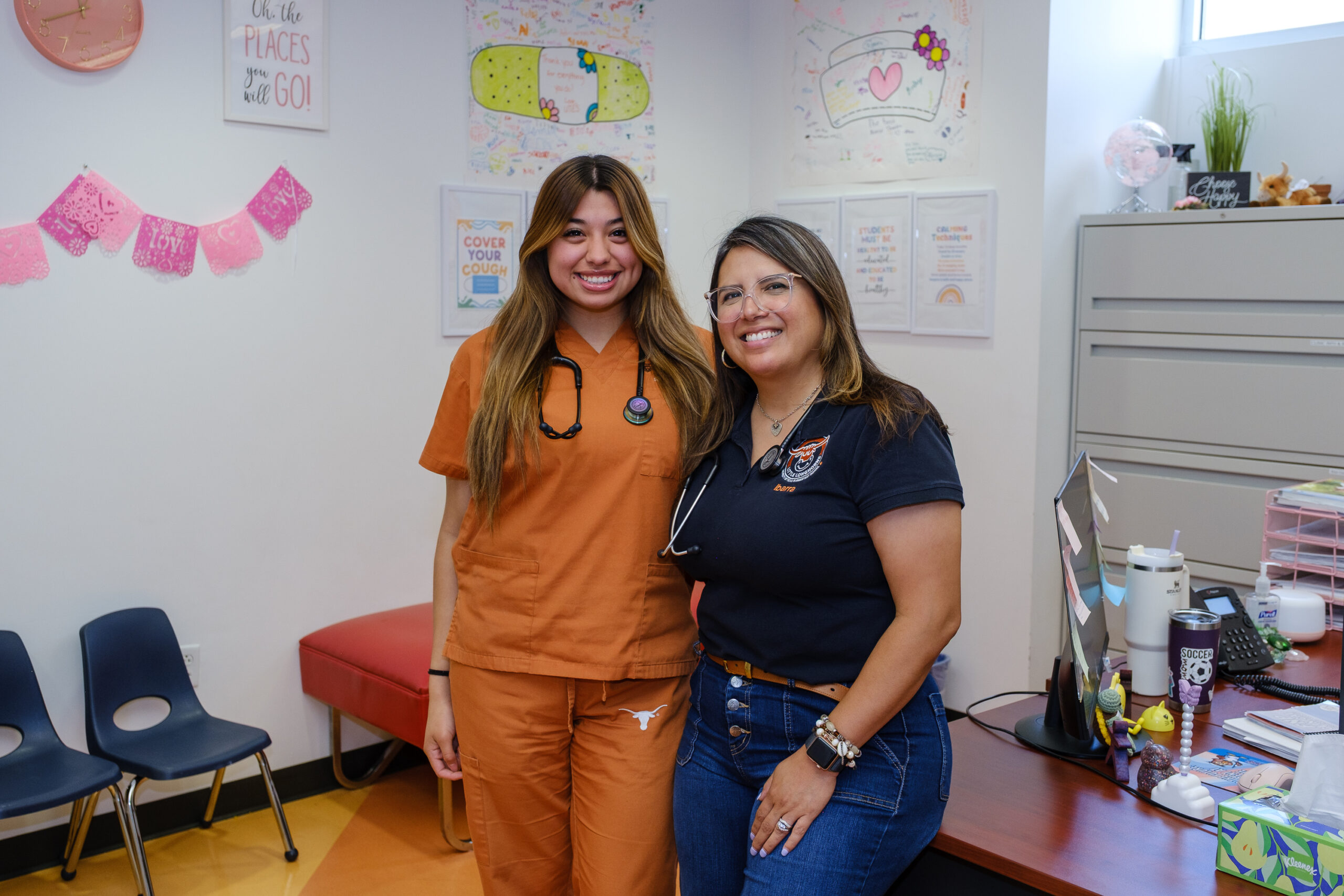
UT Elementary is more than a Pre-K – 5 school, it is a crucial training ground for future teachers, social workers, and more. This year, UT Elementary welcomed Daniela Mora, a UT Austin student who completed her Nursing Capstone under the guidance of School Nurse Rachel Ibarra. Daniela left with a perspective on nursing that she had not expected to find.
A Nursing Capstone is the culminating experience for seniors in the School of Nursing, allowing students to apply everything they have learned in the classroom to real-world clinical practice. For Daniela, who is studying to be a Labor and Delivery Nurse, UT Elementary might not seem like an obvious choice. But this pediatric rotation offered a dynamic and supportive environment that broadened her skills and deepened her understanding of the role nurses can play in the community.
Reinvigorating the School Nursing Partnership
During her first year at UT Elementary, Nurse Ibarra reviewed files left by her predecessor, Nurse Kerry Aguillon. She quickly learned about previous nursing placements at the school and the value they brought to both the Little Longhorns and students from Big UT. Inspired by that foundation and encouraged by Principal Wilder, Ibarra proactively reached out to the School of Nursing to restart the partnership. Through those efforts, she connected with Alexsis Torres, Senior Program Coordinator for Clinical Placements at the School of Nursing, to help formalize UT Elementary as a capstone site. The reinvigorated partnership premiered in the fall of 2025.
Don’t Underestimate the Role of a School Nurse
To understand what Daniela experienced, it helps to understand what school nurses actually do, which is quite a lot. School nurses play a vital role in both immediate care and broader public health efforts on school campuses. At UT Elementary, Ibarra, whose position is only part-time, responds to the everyday health concerns such as: scraped knees, upset stomachs and the occasional meltdown before a big test. She is also a first line of defense against the spread of common illnesses like the flu and pink eye, leading classroom lessons on handwashing in addition to dental hygiene. She sends home parent information on the negative effects of blue light, the importance of hydrating in the Texas heat, getting enough sleep and tips on preparing for STAAR testing.
Sometimes, the everyday activity leads to something significant. Ibarra recalled repeatedly seeing one Little Longhorn for frequent stomachaches. Through longitudinal care that is only possible by seeing the same kids, she began to recognize patterns consistent with gluten intolerance. Thanks to her observations and advocacy, the student was referred for testing and ultimately received a formal diagnosis.
Lessons in Care and Connection
For Daniela, just as in a clinic or hospital placement, she built strong clinical skills through daily patient interactions. “Each day, I get to work with different students, which has helped me learn how to individualize my plan of care based on each child’s specific needs,” she shared. But at UT Elementary, her learning extended far beyond what she might have learned in a more traditional setting: how you deliver care may matter as much as what you want to do.
During her pediatric coursework, she studied growth and development as a concept. At UT Elementary, she got to see it in action. “When a preschool-aged child came in crying with a stomachache, I approached them in a very supportive and comforting way – using a calm tone, open body language and reassurance to help them feel safe,” she explained. “On the other hand, when a 4th or 5th grader comes in with a similar complaint, I’m able to involve them more in their care by giving them choices and allowing them to have a say in their plan.” The diagnosis may look the same on paper. The care never does.
Daniela explained that unlike most clinical placements where a nursing student might see a patient only once and never learn about their long-term care or outcomes, UT Elementary gave her the opportunity to follow students across weeks and engage with students as part of an ongoing school community.
“What I’ve learned is that school nursing is so much more than treating stomachaches or handing out ice packs.” Daniela shared. “It’s about being a key part of a student’s support system and the school community. It involves health education, chronic condition management, emergency response planning, and even supporting mental and emotional health.”
Perhaps the most surprising outcome of Daniela’s placement wasn’t’ a skill she required but a career path she didn’t know existed. Working closely with Nurse Ibarra reshaped her sense of a nursing career could look like.
“She taught me so much — not only about school nursing and caring for students, but about the programs and resources that support them,” Daniela said abut Nurse Ibarra. “Seeing her ambition and determination really inspired me.” So much so that Daniela has begun envisioning a future as a Family Nurse Practitioner — a path she says she wouldn’t have seriously considered without her UT Elementary experience and her mentor.
Extending a Powerful Model of Learning, Service and Community
Nurse Ibarra is excited to continue serving as a preceptor for more UT Nursing students, helping guide the next generation of healthcare professionals through meaningful, hands-on learning experiences. She sees each placement as a preceptorship and a way to strengthen the connection between the university and the elementary school community.
School of Nursing partner Alexsis Torres echoed the impact of the partnership and the leadership behind it. “UT Elementary has been amazing with clinical placements for our nursing students. They’ve given our students real hands-on experience that’s truly helping them grow into better nurses and better people overall. Nurse Rachel is the perfect example of a true nurse leader. She might not have a supervisor title, but the way she leads with heart and dedication is changing lives, both for her elementary kids and for our students.”
At its core, UT Elementary remains deeply committed to supporting the whole child—addressing physical health, mental well-being, and the broader context of each student’s life. By welcoming nursing students into this work, UT Elementary extends that commitment beyond its own classrooms, creating a powerful model of learning, service, and community impact.
For Daniela, her UT Elementary experience was transformative. “Most importantly, school nursing teaches you how to connect with people beyond their symptoms,” she said. “You learn to see students as whole individuals—not just their diagnoses—and to provide care that is compassionate, developmentally appropriate, and community-centered. It’s an experience that builds both clinical skills and a deeper understanding of public health and trust within a community.”
She hopes her presence left a mark on the Little Longhorns, too. “I hope that seeing me in my burnt orange scrubs helps Little Longhorns imagine themselves on the Forty Acres one day.”