

Welcome UT Elementary Families!
UT Elementary was a pioneer in bringing Social and Emotional Learning (SEL) into the classroom thanks in part to the dedication of our Founding Principal Ramona Trevino, Ph.D. and community education advocates Jeanne Klein and Betsy Abell. Research that was being done in 2005 at The University of Texas at Austin was used as the roadmap for the implementation of SEL at UT Elementary. Today, our school is still a model for how SEL can and should be incorporated into elementary schools.
What is Social and Emotional Learning (SEL)?
Social and Emotional Learning is the process through which all young people and adults acquire and apply the knowledge, skills, and attitudes to develop healthy identities, manage emotions and achieve personal and collective goals, feel and show empathy for others, establish and maintain supportive relationships, and make responsible and caring decisions (CASEL).
SEL is woven into the daily life of UT Elementary. From whole-class lessons and morning meetings to small group skill-building and one-on-one support, SEL helps students build self-awareness, manage emotions, strengthen relationships, and make responsible decisions. Our SEL work is aligned with PBIS and trauma-informed practices to create a consistent, safe, and caring environment for all learners.
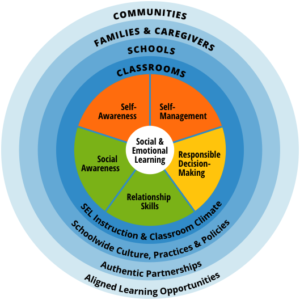
Our SEL program uses the CASEL (Collaborative for Academic, Social and Emotional Learning) wheel to engage our students, families and guardians.
The CASEL wheel highlights the five core social and emotional competencies, circled by four key settings where students live and grow.
For more information on Social Emotional Learning: Fundamentals of SEL – CASEL
Social Emotional Learning at UT Elementary
Specifically, UTES utilizes the Second Step®, a research-based curriculum designed to provide SEL throughout students’ developmental stages in their classroom. Second step programs help students learn social-emotional skills such as responsible decision-making, working together to solve problems, managing strong emotions, and getting along with others. These skills can help children succeed academically and socially.
For more information on Second Step Programs: Second Step Programs | Second Step