


1946 – 2026
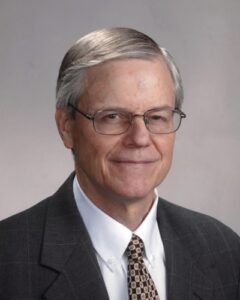
Dr. Edwin Sharpe, often called the “godfather” of UT Elementary School, passed away on Sunday, July 26, 2026. In more than six decades tied to the University of Texas, Sharpe filled almost every role the institution has to offer—undergraduate, graduate student, professor, vice president, and vice chancellor.
Sharpe was an administrator for 30 years and later taught in the College of Education Educational Administration Department. His long career began when he arrived on the Forty Acres as a freshman in 1964.
Among his greatest contributions was the founding of UT Elementary School, alongside the late Dan Burck, former Chancellor of the UT System, and Dr. Marina Walne, a lifelong educator. Sharpe attended every school management board meeting for the 17 years—170 in all.
“I have learned what it truly means to be a transformational leader by sharing the leadership role of the school with Dr. Sharpe for almost two decades,” said Dr. Melissa Chavez, who served as superintendent for the UT Charter School System and more recently as Executive Director for UT Public Schools. “He was my coach, mentor and friend. The school community loves him very much and he will be dearly missed.”
A career shaped by the Army
Sharpe grew up in a small Texas Hill Country town where his father was superintendent of a small countywide school system and his mother taught. Education, he recalled, was simply understood to be important. “I think it all came pretty naturally,” he said of that upbringing in the 1950s and early ’60s. Sharpe’s parents both held master’s degrees from UT. Family trips to Austin throughout his childhood gave Ed and his sister a long history with the university before they enrolled as students. He even learned to swim on campus at Anna Hiss Gym as a young child.
However, Sharpe’s path in education might never have happened had it not been for his military service. Sharpe was preparing to pursue an MBA in 1968, the year the United States abolished the graduate-school draft deferment. Although he had marched several times in protest of the war in Vietnam, he enrolled in a two-year ROTC program to continue his studies. When he finished. His MBA, a military obligation followed. He spent several years as an Army officer, one of them (1971-72) in Vietnam.
He counted that year among the two or three most significant experiences of his life. “It changed me significantly in terms of what I valued and where I wanted to spend my time, both professionally and in some other areas too,” he recalled in a 2010 interview. “I imagined that when I finished my MBA and had gone into business, it would have probably been with a financial institution or investment institution, but when I got out of the Army, my interests really weren’t in that direction.” Instead, he began to anticipate what else he might do with his life.
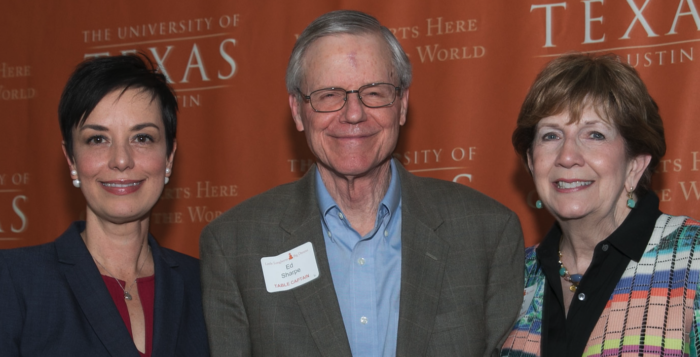
From student to servant leader
Returning home to Central Texas, Sharpe found his interests lay in higher education administration. He thought back on the administrators he had watched as a student. He remembered one Board of Regents member, in particular. He remembered his style as autocratic and, at times, forceful. “It had a significant impact on my view of the way that administrators should really deal with not only the campus community, but the broader community in the Austin area and around the state,” he said. That view was quite different. “There had been a long tradition of the way the university operated, so the notion of change and transformation was not a very comfortable one,” he explained.
He entered the doctoral program in the College of Education in 1974 and, the following year, began working for Ron Brown, the Vice President for Student Affairs. He has been employed continuously at UT or in the UT System ever since. And while the university shaped his career, the reverse was true as well: Sharpe helped make it more welcoming to people beyond campus and to students from all walks of life.
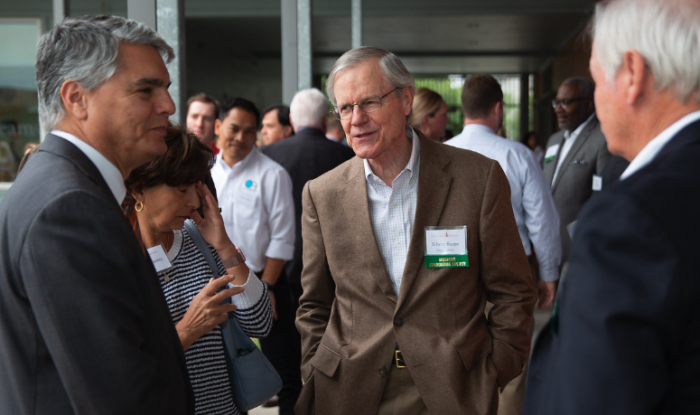
When the university began quietly buying land in the Blacklands neighborhood of East Austin in the early 1980s, Sharpe was assigned to work with residents more collaboratively than university representatives had in the past. Meeting with community groups, he heard firsthand the stories of African American families—of a time when they were not merely barred from enrolling but unwelcome even on campus. Those conversations, he said, had “a major impact on my view of the world,” and reshaped his sense of what the university owed its closest neighbors. “The institution has to always remember its neighborhood too,” he reflected.
That conviction ran through the rest of his work. With history professor George Wright and committed students, Sharpe helped launch the annual Heman Sweatt Symposium on Civil Rights, first held in 1987 after a year of planning and, on its opening morning, protest. “Once you start on the path, you have to be consistent, and you have to stay with it,” he said of winning over early critics. Later, as Vice President for Administration, he recruited Dr. James Hill in 1993; Hill would become UT Austin’s first Black vice president.
Every child, every advantage
In 1998 Sharpe was named Vice Chancellor for Academic Affairs for the UT System, working with all nine of the system’s universities. There he helped develop a plan for P-16 education known as Every Child, Every Advantage. “We tend to look at education as K-12, and then higher education, and don’t think of it as a continuum,” he explained. “The P-16 concept really means that we should look at education from birth to college and careers, a continuum focused on the social and intellectual development of students.” He was blunt about why the earliest years matter: children from lower-income families can enter pre-K as much as a year and a half behind their peers, a gap that is very hard to close.
That belief found its fullest expression in 2002, when Chancellor Dan Burck tasked him with creating an elementary school—a public charter designed to serve a diverse group of students in East Austin. Working with a team that included Burck, Walne, Perry Lorenz and Pat Oles, Sharpe helped locate a tract of former city land in an undeveloped stretch of East Sixth Street. The rest, as they say, is history. UT Elementary now serves students Pre-K through Grade 5, has helped train more than 500 pre-service teachers, and remains a demonstration school for best practices in urban education, serving a majority of students from low-income backgrounds.
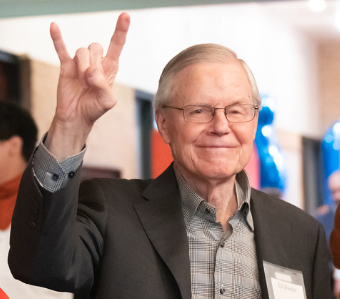
Always unassuming, humble and kind, Sharpe was a model of servant leadership. He said, “I think that ultimately we as human beings have a need to know each other, to understand the challenges that we each have, and open our hearts and minds to that community feeling—that sense that we really are in this together, and we’re able to deal with the challenges collectively and find paths to move forward together.” Asked once about his personal philosophy, he answered simply that we are called “to care about people, and ultimately to love our neighbors.”
Whether working with East Austinites, helping the university confront its history of racism, or building a school where students from diverse backgrounds could succeed, Ed Sharpe brought hearts and minds together for the highest calling.
Read his obituary and consider giving to the Ed Sharpe Memorial Giving fund.