

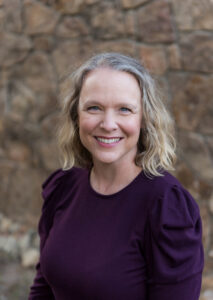
When Elizabeth Swanson, a research professor with the Meadows Center for Preventing Educational Risk in the College of Education, thinks about her research, she sometimes travels back in time to a resource room at Andrews Elementary School in Austin in the late 1990s. There she taught first through fifth graders with disabilities. Every child, regardless of their specific need, was funneled into the same room, rotating in and out all day for reading and math.
“I think about my kids back then and I’m like, how did I even do that?” she says. “But throughout my entire career, that group of kids is kind of at the back of my mind. I think of them all the time.”
Swanson’s experience as a classroom teacher was followed by a pivot to a PhD at UT Austin, where she was unexpectedly “shocked” by how deeply she fell in love with research. But her teaching experience has shaped everything about the project she leads today with UT Elementary School and several schools in San Antonio.
Funded by the federal Office of Special Education Programs, the study is called Computer-Assisted Collaborative Strategic Reading, or CA-CSR. It is designed to improve reading outcomes in English for emergent bilingual students in third through fifth grades.
The “emergent bilingual” label refers to students who are developing proficiency in English while maintaining a home language and mostly that language is Spanish. The project includes students with and without disabilities, all of them learning side-by-side in the regular classroom. That last detail matters to Swanson. After years of watching students with disabilities spend their school days separated from peers, she has built her entire research agenda around what those kids need when they’re included in the general education setting.
CA-CSR works by pairing students — ideally with a shared home language — and walking them through a structured process with informational text. First, they preview the passage. Then they read it. Students then engage in a systematic set of comprehension strategies, identifying the main idea, asking and answering academic questions, and discussing the content with their partner before the teacher brings the whole class together for a broader conversation.
“It’s pretty feasible once teachers get their kids trained on the strategies,” Swanson explains. “The kids work independently with their buddy, and then the teacher monitors and helps kids who need help.”
The computer-assisted piece adds a crucial layer of support. The project uses an online platform that hosts informational passages in science and social studies, all aligned to Texas state standards. Students can toggle between English and Spanish versions of each text. They can switch between easier and harder passages. And they can have any section read aloud to them. Many of these features mirror common accommodations for students with disabilities, deliberately baked in so that no student needs to feel singled out for extra help.
“When we were developing this, we asked teachers what features they wanted, and they said overwhelmingly: make it simple,” Swanson says, laughing. “You’ll see that reflected in the website. It’s definitely not flashy. But teachers love it.”
One of the project’s most striking elements is what happens in those student pairs when the strategies really click. Swanson describes watching emergent bilingual students move fluidly between English and Spanish as they puzzle through a passage together — discussing ideas in whatever language comes most naturally, then helping each other find the right words when it’s time to write in English.
“I don’t speak a whole lot of Spanish, so sometimes when they switch to complete Spanish I’m a little lost,” she admits. “But it is really neat to watch. They’re bringing these assets to bear in Spanish and English and then one of them is helping the other. ‘here’s how you do it in English.’ It’s just really neat.”
The study is now in its third year overall, and Swanson’s team has been gathering data at multiple levels:
- Reading comprehension gains over time,
- Teacher perceptions of feasibility and effectiveness, and
- Student feedback collected in end-of-year focus groups.
This year was the first year UT Elementary participated in the project. At other partner schools, students have already shown measurable reading gains from fall to spring.
What distinguishes this phase of the research from earlier studies of the Collaborative Strategic Reading approach, Swanson notes, is that the researchers have deliberately loosened their grip. Previous trials were tightly controlled. Researchers dictated which texts to use, how often to meet, and every other variable. This project asks a different question: How does the intervention perform when it’s released into real classrooms, with real teachers making their own decisions?
So far, the answer seems to be it’s going well. And somewhere in the back of Elizabeth Swanson’s mind, a resource room full of kids who never got quite the right support would be cheering them on.